Mathematics
— Coordinate Systems
[Rectangular Coordinate System]
Cartesian
coordinate system: another name
Cartesian
coordinate system in one dimension:
a point x on a straight line. 
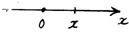
Cartesian
coordinate system in two dimensions: a
point (x, y) on the xy-plane. 
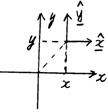
Cartesian
coordinate system in three dimensions:
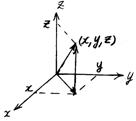
Base
vectors: 
 : in the direction of increasing x with y and z held constant.
 : in the direction of increasing y with z and x held constant.
 : in the direction of increasing z with x and y held constant.
They are all perpendicular to each
other:

Base vectors are constant once
they are defined.
The
right-hand rule: 
Coordinate
of a point: 
Position
vector: a vector from (0, 0, 0) to (x, y,
z). 
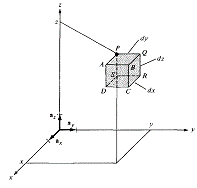
Incremental
length: 
Incremental
area: 
Incremental
volume: 
[Cylindrical Coordinate System]
Cylindrical
coordinate system in two dimensions:
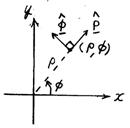
Base vectors:

Polar-to-rectangular
base vector conversion:
Since  is on the
xy-plane, it can be represented by a combination of and :
is on the
xy-plane, it can be represented by a combination of and : 
Angle between and :  →
→ 
Angle between and :  →
→ 
Thus,

Angle between  and :
and :  →
→ 
Angle between and : → 
Thus,

In summary,
,
Conversely we have
 ,
, 
Coordinate of a point:

 : distance from (0, 0) to the point
: angle measured in counterclockwise direction from the
positive x axis to the line segment
from (0, 0) to
Polar-to-rectangular
coordinate conversion:


Position vector:

Cylindrical coordinate
system in three dimensions:
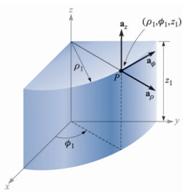
Base
vectors:  . They are all perpendicular to each other. Base vectors change directions
as the point moves.
. They are all perpendicular to each other. Base vectors change directions
as the point moves.
The
right-hand rule: 
Cylindrical-to-rectangular
base vector conversion:
, .
, .
Coordinate
of a point: 
Cylindrical-to-rectangular
coordinate conversion:


Position vector:

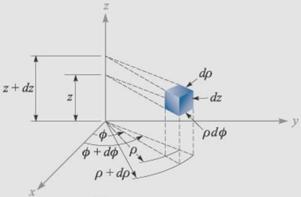
Incremental
length: 
Incremental
area: 
Incremental
volume: 
[Spherical Coordinate System]
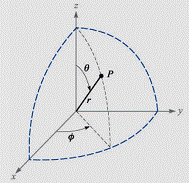
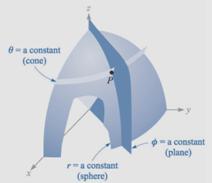
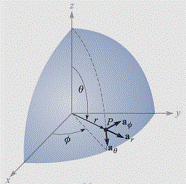
Base
vectors:  . They are all perpendicular to each other. Base vectors change directions as the point moves.
The
right-hand rule: 
Spherical-to-rectangular
base vector conversion:
Angle between  and :
and :  →
→ 
Angle between and xy-plane:  →
→ 
Thus,

Angle between  and :
and :  →
→ 
Angle between and xy-plane: → 
Thus,

Angle between and : →
Angle between and : → 
Thus,
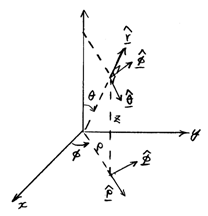
In summary,


Conversely we can obtain:



Coordinate
of a point: 
Spherical-to-rectangular
coordinate conversion:


Position vector:

Incremental
length: 
Incremental
area: 
Incremental
volume: 