ARTILLERY
FUZE
1. Technology Trends
-
Enhanced battlefield performance
-
Low cost
-
Improved ECM resistance
-
Better immunity to reverse engineering
-
Adaptable for a wide array of systems and target types
-
Software defined HOB
-
DoD fuze IPT (Integrated Product Team)
-
PM CAS (Project Manager Combat Ammunition Systems)

-
Upgrade the sensing method:
2.
Development Tasks
-
Requirements
-
Simulations and algorithms
-
Antenna, transceiver, FPGA developments
-
Laboratory prototype
-
Detailed design
-
Evaluation and field test
-
Overview:
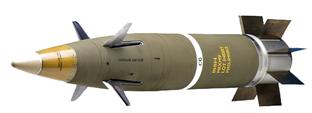
M982,
Raytheon/ Bofors/ General Dynamics, 155mm, 10-m CEP (typically 4-m), 30/50km
(threshold), 40/60km (objective), accuracy as much by target location error as
by navigation.
Rationale:
Enhance
the capability of howtizer ammunition by an order of magnitude, point accuracy
against CP, ADA, building, vehicle; aerial denial to platoon in open; massed fires
for suppression, large LTE; minimized collateral damage, extended range by
gliding, top attack in urban terrain, reduced logistics/costs
Operational
concept:
Firing
orders are sent digitally to each gun in a battery. Before loading, the
guidance system is progrmmed with target coordinates, predicted weapon
trajectory, GPS cryptography codes, fuzing data and other information.
Boost-glide profile is used to extend the range. The rear fin pops out right
after firing, rotating freely relative to the spinning shell. As the M982
reaches apogee, canard control fins deploy and de-spin the weapon for GPS to
get a signal. At decent, the guidance system compares trajectory to the
predicted track. Excalibur then performs a pull-up maneuver into an extended
gliding profile, before a final pitch-down to the target in a vertical drive.
Long-term
evolution:
Fire-and-forget,
not dependent on SAL
1)
Block I (Unitary): HE warhead, GPS/IMU guidance, Block 1a-1 = 24km, Block 1a-2
= 40km put to service
in 2009, Block 1b = to
cut cost by redesigning electronics and actuation system. Ballistic trajectory
is used
instead
of gliding. SAL or IR or MMW seeker in the nose section for 1-m CEP. Raytheon.
Delivery in 2012.
2)
Block II (Smart): detect/acquire/engage submition capability
3)
Block III (Discriminating): terminal guidance
Government
and military agencies related to Excalbur:
-
US DoD CAS (Combat Ammunition Systems) Project Manager
-
ARDEC - TACOM
-
TSM Excalibur
-
FMW
Contractors:
1)
Major contractors
-
Raytheon Missile Systems (USA): total system
-
Bofors Defence (Sweden): base, airframe, warhead
-
NAMMO (Norway): basebleed
-
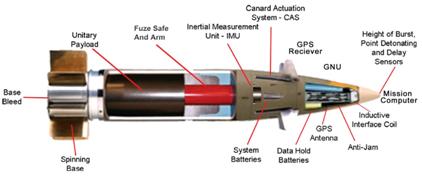
BAE (England): IMU. Gun-hardened
IMU by Atlantic Inertial System (merged with BAE Goodrich's
Sensors and Integrated
Systems in Dec. 2009) = SilMU02®. Only IMU that can withstand 20kg.
MEMS-based.
2)
Parts suppliers
-
Anti-jam: EDO - CCS (ANC) (CA)
-
Batteries: Eagle Picher (MO)
-
CAS: GD - OTS Healdsburg (CA)
-
CAS production and metal parts: GD - DRI (AL)
-
Final integration: McAlester AAP (OK)
-
FSA & HOB: L3 - KDI (OH)
-
GNC production line: Raytheon - NAPI (NM)
-
GPS antenna: M/A-COM Tyco Electonics (MA), PCTEL (IL) munitions guidance
antennas(cover L1 and
L2. Excalibur M982,
ERGM, Enhanced Paveway II, AGM-88 HARM)
-
GPS receiver: L3 - IEC (CA). Interstate Electronics Corp., SAASM-based GPS
receiver. 12-ch,
government-supplied Key
Data Processor(KDP), a tamper-resistant coated multichip module, 15kg
gun-hardened
-
IMU: Honeywell (MN)
-
Metal parts: Klune Industries (UT)
-
MC & PCU CCA's: Primus (PA)
-
Radome: Raytheon Electronic (TX)
-
Tactical telemetry transmitter: M/A-COM Tyco Electonics telemetry transmitter
module, telemetry
antenna
-
Warhead LAP: American Ordnance (IA)
-
Warhead: GD - OTS OTI (FL)
Ammunition
components:
-
Inductive fuze setter interface, inductive fuze setter (Portable Excalibur Fire
Control System)
-
GPS antennas
-
Anti-jam GPS/IMU navigation
-
Slipping obturator
-
Folding fins
-
Modula payload
-
Canard control/guidance