Coaxial Cable
[Construction
of a Coaxial Cable]
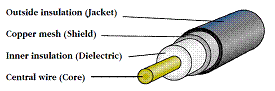

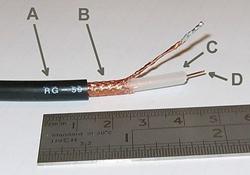
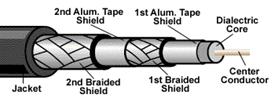
Core (inner conductor): sinle wire in thin cables. Two or more wires braided in thick cables for increased flexibility. materials = copper alloy, silver-plated copper alloy, copper-plated steel
Dielectric (dielectric sheath): materials = air or nitrogen filled with nylon spacer, solid or foam polyethylene
Shield (conductive shield, outer conductor): one or more braided layers of fine metal wires in flexible cables. Solid metal tubing in semi-rigid and rigid cables. In braided cases, the electromagnetic shield is finite and frequency-dependent. In some cases, a layer of coated aluminum foil is placed between the dielectric and the braided wires, or the foil is the only shield used. Materials = copper or aluminum alloy.
Jacket (insulating jacket. outer sheath): a tough material such as PVC is used. Polyethylene is used in buried coaxial cables for more waterproofing. Critical applications require additional protection such as gopher tape or steel wire reinforcement.
[Operating Principles and
Field/Current Distribution]
Modes: TEM, higher-order modes. Upper limit of recommended operating frequencies vs. cable diameter.
Electric field (E): plot of E for TEM and higher-order modes
Magnetic field (H): plot of H for TEM and higher-order modes. Relationship between E and H.
Current ( I ) : on inner and outer conductors. The skin effect. Relationship between current and magnetic field.
Voltage (V): between inner and outer conductors. Relaltionship between voltage and electric field.
Characteristic impedance (Zc, Z0): definition. Why do we use 50-ohm cables most of the time? What's the difference between 50-ohm and 75-ohm cables? Formulas and equations related to characteristic impedance.
Cable parameters: R, L, G, C. Frequency dependency.
Attenunation
Phase velocity
Dispersion
Impedance (Z): the difference between Zc and Z. Impedance matching.
[Dielectric Spacer]
PE (poyethlylene, solid): good for low temperature applicaton
FPE (foamed PE): provides lower attenuation and capacitance than solide PE
FEP (fluorinated ethylene propylene): excellent for high temperature and plenum applications. Has a lower dielectric constant.
FFEP (foamed fluorinated ethylene propylene): extremley low dielectric constant and low loss.
Air Spaced: cable diameter can be decreased.
[Shielding]
Foil shield: a layer of aluminum foil with a polyester backing. Overlapped to provide 100% covering.
Braided shield: a layer of interwoven thin strands of aluminum, tinned copper or bare copper. Many differente coverings are availabe with 40-67% aluminum and 95% copper being the most popular. The higher the covering, the higher the EMI shielding.
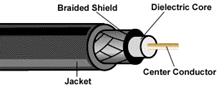
Foil/braided shield
A foil-braid shield that is popular
with CATV and MATV applications. A 100% aluminum foil accompanied by a braided
shield. It provides improved protection from EMI than a single shield. Ccalled
dual or double shield.
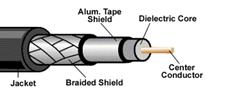
Triple-shield or Tri-shield
A foil-braid-foil shield.
Quad-shield
A foil-braid-foil shield that is
popular for CATV and MATV applications in high EMI/RFI locations such as urban
areas.
[Jacket]
The jacket is the oute sheath of a
coaxial cable. Its main function is to protech the cable from the environment
and damages. The choice of jacket materials is based on the temperature rating
(low, medium, and high) and the location rating (plenum, wet, sunlight
resistant, etc.).
PVC (polyvinyl chloride): Very
flexible. For general applications. Good for -40 to 80 °C.
PE (polyethylene): For direct burial
applications. Good for -55 to 80 °C.
FEP (fluorinated ethylene propylene):
Good insulating properties.
[Cable Types]
(According to Flexibility)
Flexible cable: braided wires for outer conductor. The cable can be bent freely by hand
Semi-rigid cable: solid tube for outer conductor. The cable can be carefully bent.
Rigid cable: solid tube for outer conductor. The cable is not supposed to be bent.
(According to Characteristic Impedance)
50-ohm cable
75-ohm cable
(According to Cable Type Names)
RG (Radio Guide)
[Connector]
BNC (Bayonet Neill Concilman)
[RG-6 Cable]
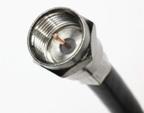 (RG-6 cable connector)
Usage: for digital CATV, satellite TV, digital audio, and broadband Internet applications. RG-59 is an older thechnology. RG-6 offers an improved performance over a wide frequency range.
Limitation: RG-6 is not good for operation at lower than 50MHz (video projectors, component video and plasma TVs).
Specifications: 70-ohm characteristic impedance. Has one or multiple braided shields with at least 95% coverage of the inner conductor.
Center conductor: a single wire of copper or copper-clad steel.
RG-6 basic: a single braided shield. Does not have a sufficient shielding. Used in short-run connections between equipments.
RG-6D double shield: a foil shield and a wire mesh shield. Used to connect the outdoor antenna to the indoor equipment. The center conductor is usually of braided type.
RG-6Q quad shield: the most commonly used type in the RG-6 family. A double foil and twin-braided shield laid in alternating layers, all made of aluminum. Commonly used for outdoor applications that extend over long distances.
[RG-59]
Usage: for applications at lower than 50MHz.