L10a-5G Mobile
Communication
CONTENTS
1. What's new in 5G?
2. Glossary
3. Modulation (Waveform Design) in 5G
4. Multiple Access Schemes in 5G
5. MIMO technology in 5G
6. 5G and IoT
7. SoC and IC solutions
for 5G
8. Emerging Applications Based on 5G
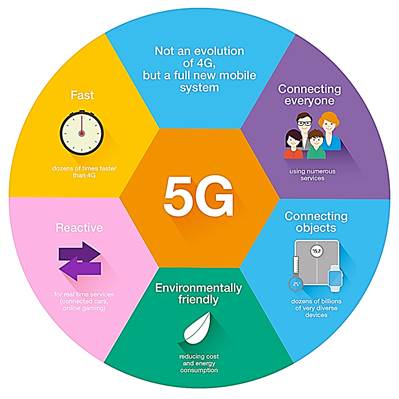
1. What's new in
5G?
2. Glossary
MIMO (multiple input multiple output)
RAD (radio access technology)
RAN (regional area network)
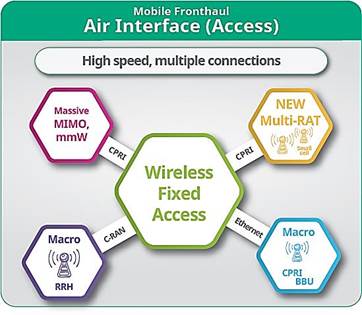
c-RAN
(cloud RAN)
mIoT
(massive IoT)
eMBB
(enhanced mobile broadband)
URLLC (ultra reliable low
latency communication)
RoE
(radio over ethernet)
RRH (remote radio head)
RRS (radio remote system)
BBU (base band unit)
RCC (radio cloud center)
UDN (ultra dense network)
CPRI (common public radio interface)
eCPRI
(enhanced CPRI)
3. Modulation
(Waveform Design) in 5G
4. Multiple
Access Schemes in 5G
1) OFDMA
(orthogonal frequency division multiple access):
- OFDM (orthogonal frequency division multiplexing):
Users use a fixed (in time) set of subcarriers.
- OFDMA: Users use a time-varying set of
subcarriers.
- Very successful in 4G mobile communication
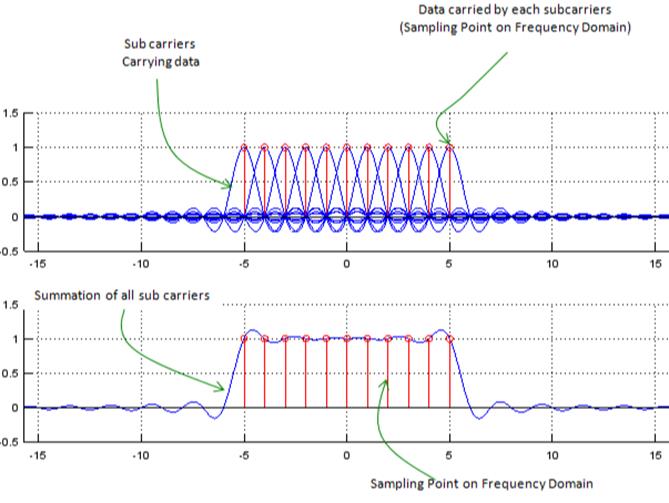
- Carrier bandwidth is subdivided into many
subcarriers.
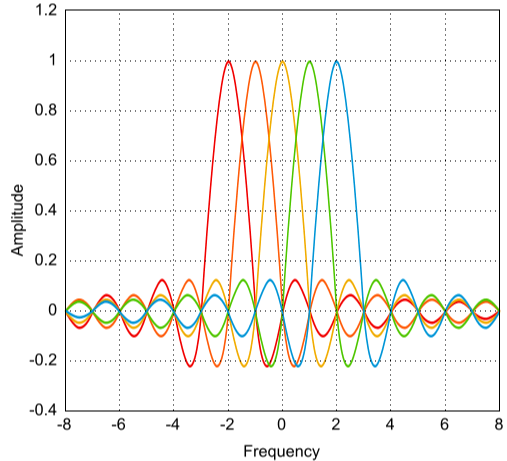
- Subcarriers are orthogonal (or non-interfering) to
each other.
- A user uses one or more subcarriers.
- Each subcarrier is digitally modulated.
- OFDMA: High peak-to-average power ratio ¡æ not used in the uplink (from
mobile phone to base station)
- Procedures:
Tx:
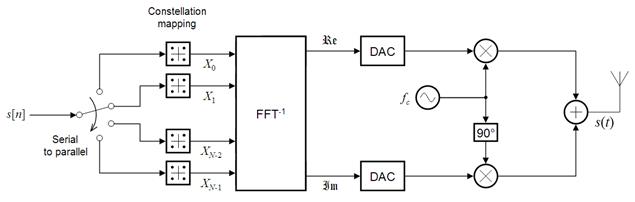
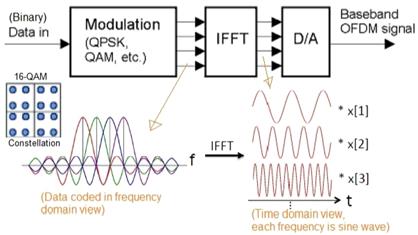
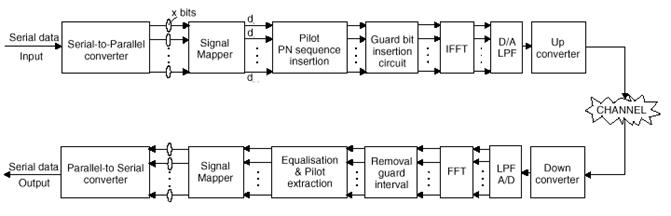
Parallelization of symbols ¡æ Modulation (QPSK, 16-QAM, 64-QAM) ¡æ IFFT to
generate OFDM symbols ¡æ Add a cyclic prefix to avoid inter-symbol interference
Rx: FFT ¡æ
Demodulation ¡æ Serialization
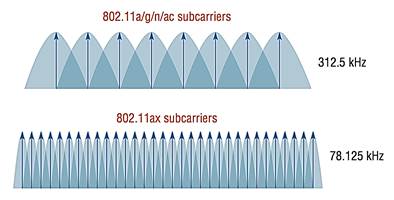
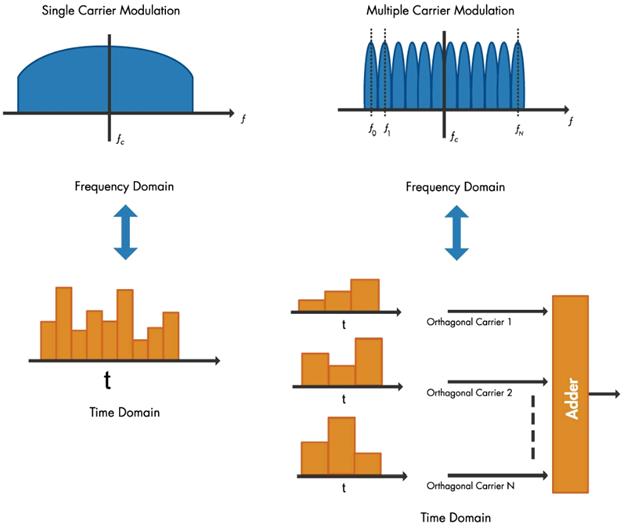
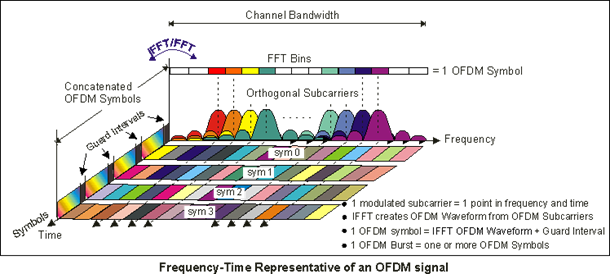
Figure: OFDM concept
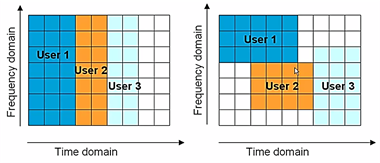
Figure: Left = OFDM, right = OFDMA
2) SC-FDMA
(single carrier frequency division multiple access):

- Used in the uplink.
- Low peak-to-average power ratio
- Procedures:
Tx:
Parallelization of symbols ¡æ Modulation (QPSK, 16-QAM, 64-QAM) ¡æ DFT pre-coding ¡æ IFFT to generate OFDM
symbols ¡æ
Add a cyclic prefix to avoid inter-symbol interference
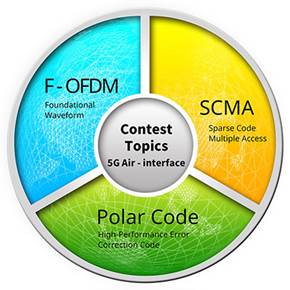
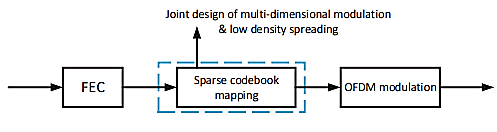
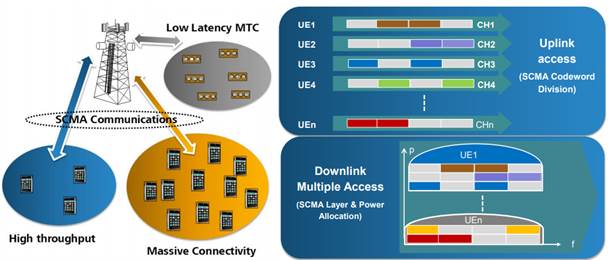
3) SCMA (sparse
code multiple access):
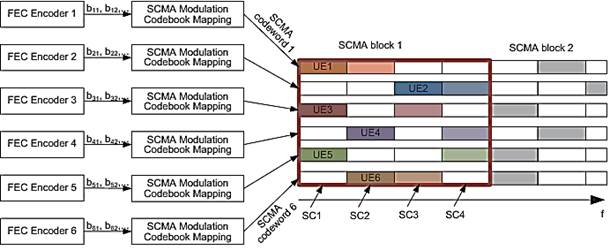
- In OFDMA, a subcarrier (or a set of subcarriers)
is allocated to a user.
- Each subcarrier has a spreading code added to it.
- Each subcarrier can be used by multiple users.
4) NOMA
(non-orthogonal multiple access):
- Combine multiple users in power domain
- Use cancellation techniques to remove the more
powerful signal.
- Methods: OFDMA, DFT, DFT-spread OFDM
5.
10.1.2 PAPR
(peak to average power ratio)
1) PAPR
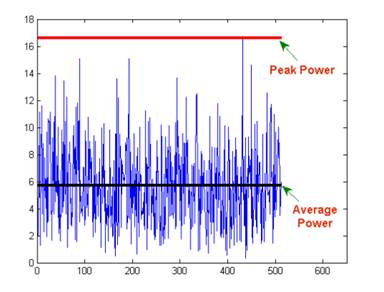
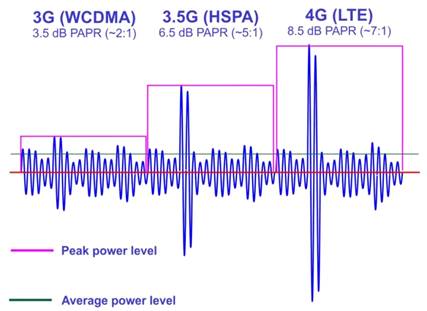
- PAPR: The maximum power of a
sample in a given OFDM transmit symbol divided by the average power of that
OFDM symbol.
- PAPR occurs when in a multicarrier system the different sub-carriers are out of phase with each other. At each instant they are different with respect to each other at different phase values. When all the points achieve the maximum value simultaneously; this will cause the output envelope to suddenly shoot up which causes a ¡®peak¡¯ in the output envelope.
- Due to presence of large number of independently modulated subcarriers in an OFDM system, the peak value of the system can be very high as compared to the average of the whole system.
- In LTE system, OFDM signal PAPR is approx. 12dB.
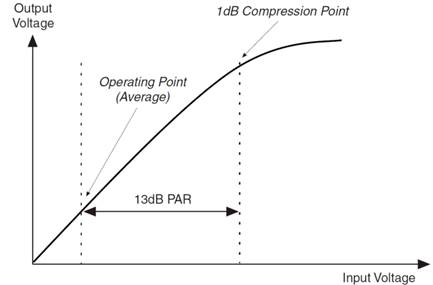
2) Power amplifier (PA) backoff:
- PA back off:
Average
power: 40 dBm
PAPR:
12 dB
PA
saturation point: 52 dBm
PA
operating point: 40 dBm
PA
back off: 12 dB
- Large back off: low efficiency
3) CFR (crest factor reduction)
- CFR: Reducing PAPR
- CFR algorithms:
Clipping
and filtering (CF)
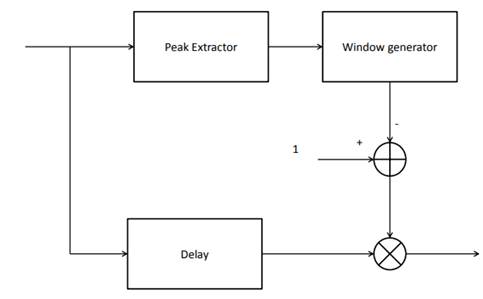
Peak
windowing (PW)
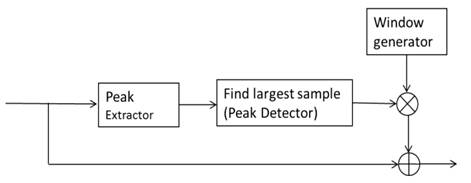
Peak
cancellation (PC)
Selective
mapping (SLM)
- After CFR, PAPA is reduced to 7.5
dB from 12 dB.
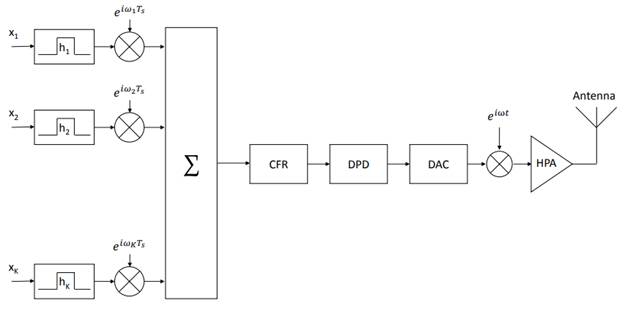
S : aggregator
DPD
(digital pre-distorter)
DAC
(digital to analog converter)
HPA
(high power amplifier)
- Selective mapping technique
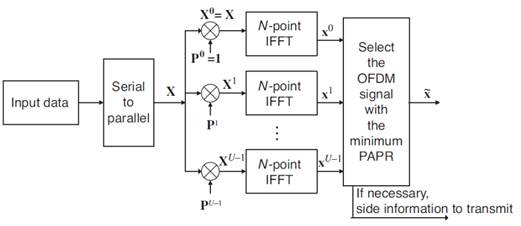

Figure: OFDM procedure with
selective mapping
- Peak cancellation algorithm
- Peak windowing algorithm
10.1.3 OFDM
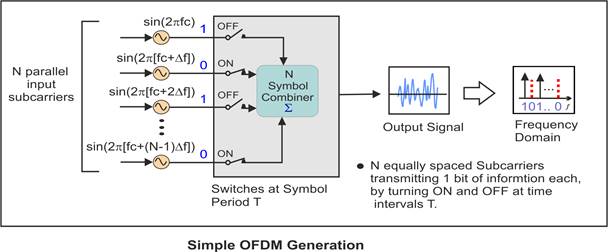
1) OFDM signal: Tx chain
2) OFDM signal: Rx chain
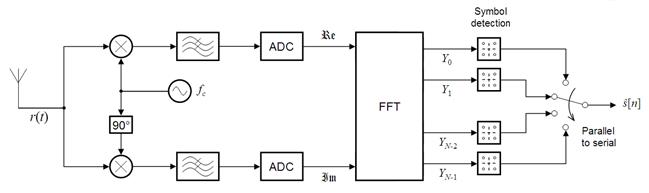
3) OFDM signal in time domain


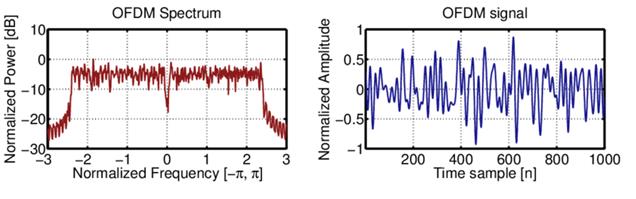
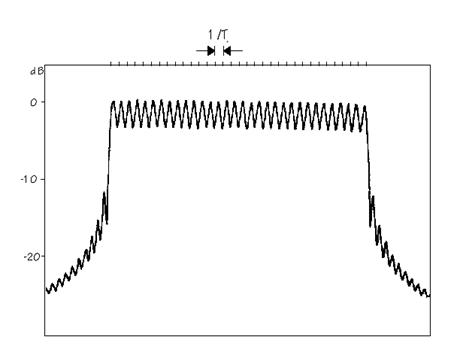
4) OFDM signal in frequency domain
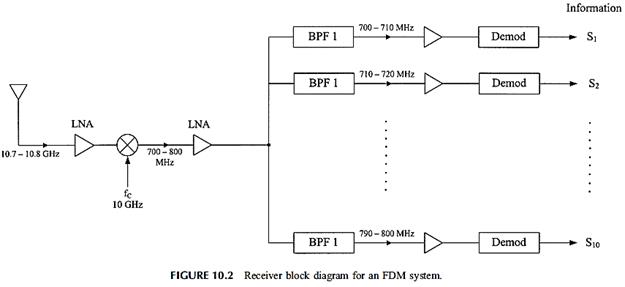
10.2 Frequency
Division Multiple Access
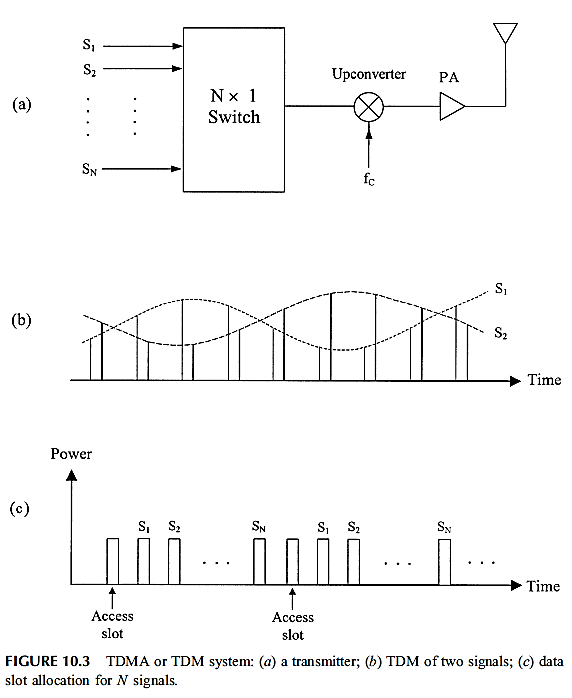
10.3 Time
Division Multiple Access
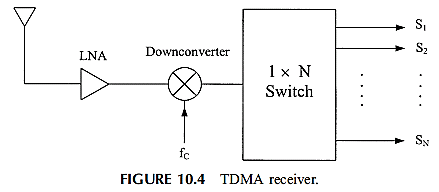
10.4 Spread Spectrum and Code Division Multiple
Access
10.4.2 FHSS (frequency-hoping spread spectrum)